
[ad_1]
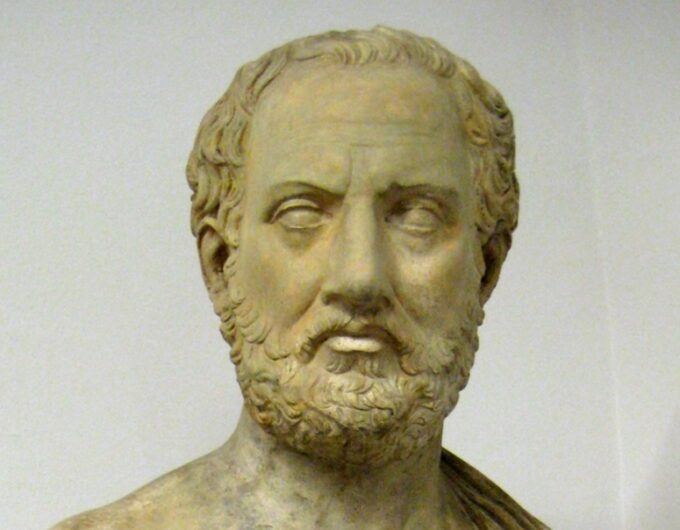
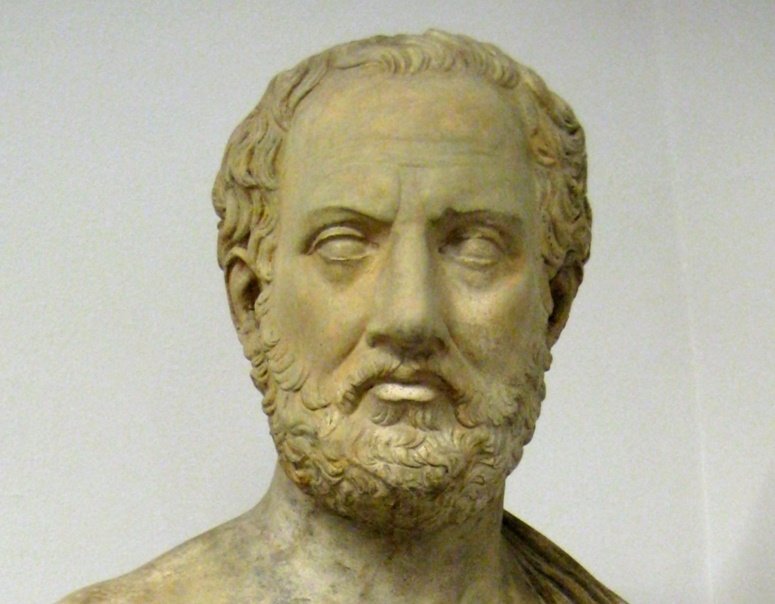
Thucydides. This is the plaster cast bust currently in exposition of Zurab Tsereteli’s gallery in Moscow. Photograph Source: shakko – CC BY-SA 3.0
History doesn’t repeat itself, but there are relevant analogies in any discussion of historical events, and these can be helpful. The current tensions in Sino-American relations are reminiscent of both the Peloponnesian rivalry and war between Athens and Sparta in the 5th-century B.C. (as recounted by the Athenian historian Thucydides) and the European rivalry between Germany and Britain in the years before World War I.
Harvard Professor Graham Allison wrote about the example of the Peloponnesian rivalry 11 years ago in a book titled “The Thucydides Trap.” He argued that Sparta had established regional dominance, and that Athens’ efforts to contest that dominance led to a long war that was labeled the first “forever war.” In the years before the outbreak of World War I, Britain had used its naval power to establish regional dominance, but Germany’s building up of its own military forces, particularly its naval forces, produced tensions that contributed to the start of the war in 1914.
No one predicted the horror and slaughter of WWI that left Europe in ruins and contributed to the end of the Russian, Ottoman, and the Austro-Hungarian empires. Four years of war moved Europe from the political center of the global community to a weakened condition that opened the door to the Bolshevik Revolution in Russia and ultimately to fascism in Germany and Italy. During a trip to the United States in 2015, Xi said there was no such thing as a “Thucydides Trap” in the world, but that, “should major countries…make the mistake of strategic miscalculation, they might create such traps for themselves.”
These earlier events resemble the current rivalry and tension in Sino-American relations, which find the United States losing international influence and credibility while China is emerging as a serious rival to the U.S. standing as the leading global power. At the recent summit meeting between Donald Trump and Xi Jinping, which featured the U.S. president going to Beijing virtually “hat in hand” to improve bilateral political and economic relations, the Chinese leader lectured Trump about U.S. risk-taking regarding the use of force in general and the posturing over Taiwan in particular. Xi then reached deep into history, warning Trump about mishandling the Taiwan issue, as that could lead to a greater conflict.
I personally don’t believe that China is about to use military force to solve its Taiwan problem because China is in an advantageous position to prosper from the political and economic environment in the Indo-Pacific region. China, moreover, must be concerned with the recent successes of Ukraine, Iran, and Hamas against far stronger opponents (Russia, the United States, and Israel) that assumed their wars would be extremely short ones.
And I believe even more strongly that the United States and China are not headed toward a violent confrontation, which would not serve the interests of either nation. But wars have become such a consistent feature of international relations that the possibility of conflict cannot be dismissed. The recent examples of futile and costly “endless wars” make it even more pertinent to examine the risks of accidental warfare between the United States and China and to appreciate the possible mishandling of bilateral relations that could lead to war. The gratuitous propaganda wars pursued by both sides and the absence of a regular strategic dialogue contribute to the tensions and the rivalry.
The national security situation in the United States is particularly worrisome because U.S. personnel and processes that make up the decision-making process are so weak and poorly managed. Trump has loaded up his national security team with China Hawks who don’t value the importance of diplomacy and dialogue. The fact that Marco Rubio is both Secretary of State and National Security Advisor, and has driven both institutions into the ground, is not reassuring. The fact that two real estate billionaires without experience or knowledge dominate U.S. diplomatic dealings is risible. There is not a single expert on China in the Trump firmament.
China, meanwhile, has a very polished and experienced national security team and has been very successful in the Indo-Pacific and the Global South without relying on military force. It is noteworthy that China has a trade surplus of $1.2 trillion at the same time that the United States has a trade deficit of $1.2 trillion. China has avoided the kind of absurd adventures that the United States has pursued in wasting blood and treasure in unnecessary wars in the Middle East and the Persian Gulf over the past 25 years.
U.S. policy makers, politicians, and pundits are too preoccupied with the threats of violent Islamic extremism and the resurgence of Russian power, and have been derelict in ignoring China’s ascendance in all aspects of economic, technological, and military power. For the past two decades, the United States has assumed it could contain China’s power just as it contained the power of the Soviet Union in the 1960s and 1970s. The Soviet Union, however, was never a global power and never possessed strong economic power. Conversely, the magnitude of China’s power over the years has been rapid and profound. I don’t believe that Trump, JD Vance, and Rubio understand this fact.
[ad_2]
Source link
