
[ad_1]
President Donald Trump’s recent answer to a question about how Americans are faring economically sparked claims of callousness.
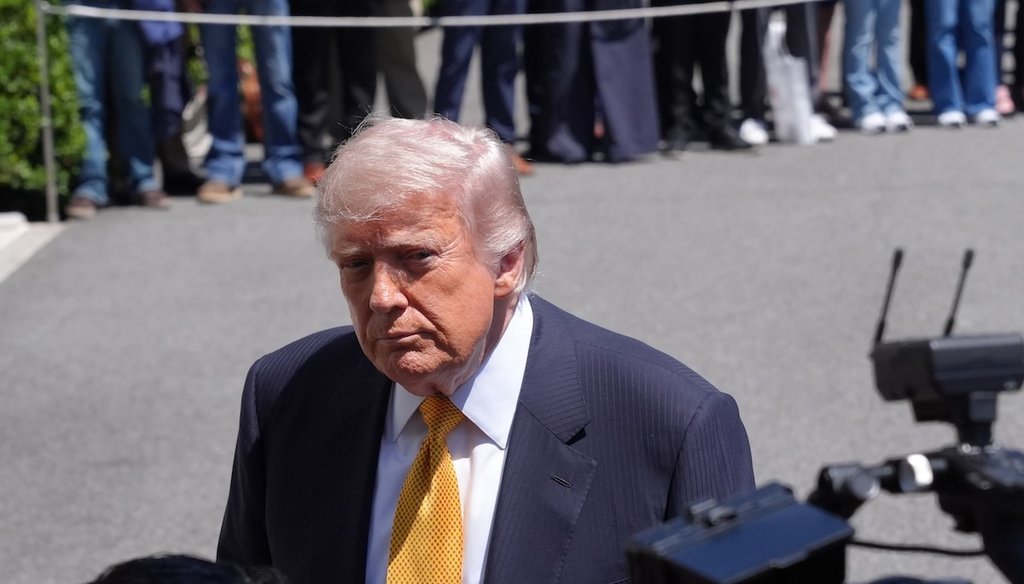
A reporter asked Trump on May 12 how much Americans’ financial situations factor in when he’s weighing decisions about Iran.
Trump responded, “Not even a little bit. The only thing that matters when I’m talking about Iran, they can’t have a nuclear weapon. I don’t think about American(s’) financial situation. I don’t think about anybody. I think about one thing. We cannot let Iran have a nuclear weapon, that’s all. That’s the only thing that motivates me.”
Democrats, including House Minority Leader Hakeem Jeffries, D-N.Y., and Senate Minority Leader Chuck Schumer, D-N.Y., quickly pounced. “Trump’s clueless comments make my blood boil,” Schumer said on the Senate floor. “Americans can’t understand how a president could be so cold, so callous. And so proud of it.”
In light of Trump’s comment, we decided to examine how the economy is treating average Americans.
We looked at metrics for inflation, wages, job creation, consumer debt and public opinion surveys about the economy. We asked the White House to suggest its own metrics, but it did not share any.
In a statement to PolitiFact, White House Communications Director Steven Cheung focused on the question’s original context: the Iran war and negotiations to end it.
“The President’s ultimate responsibility is the safety and security of Americans,” he said. “Iran cannot have a nuclear weapon, and if action wasn’t taken, they’d have one, which threatens all Americans.”
Douglas Holtz-Eakin, president of the center-right American Action Forum, said on the economic front, there’s not a lot to celebrate.
“For the majority of Americans the economy is close to stagnant — little hiring (or firing), real wages nearly flat, sustained inflation, and little optimism that things will change,” Holtz-Eakin said.
In seven charts, we show how the U.S. economy is performing for average Americans.
Prices for key goods and services have increased
Rising prices are a big concern for many Americans, after experiencing an inflation peak around 9% in 2022.
In six broad categories tracked by the Bureau of Labor Statistics — groceries, electricity, housing, apparel, medical care, and tuition and childcare — prices have not only risen during Trump’s presidency but also have risen faster than the 2% inflation rate that the Federal Reserve targets.
The increases during the first 16 months of Trump’s second term have ranged from 3.2% for groceries to 8.7% for electricity.
Gasoline is another major item many Americans purchase, and its price has soared since Trump launched the Iran war in February and Iran responded by blocking the Strait of Hormuz.
Today’s nationwide average gasoline price per gallon is among the highest ever recorded.
Mortgage rates also fell from 6.96% when Trump took office in January 2025 to 5.98% in late February, but they have since risen to 6.36%.
Wages outpaced inflation early in Trump’s second term, but not anymore
Early in 2025, wages grew robustly, consistently outpacing inflation. But inflation has picked up since the Iran war started, and now those early wage gains have all but disappeared.
Consumer loan delinquency has risen steadily
Feeling the inflation squeeze, consumers are struggling more with debt as they turn to credit to cover costs. One measure, the share of loaned money that is delinquent in being repaid, has increased steadily during Trump’s second term.
Delinquency rates for credit card debt and auto loan debt are roughly the same as during the Great Recession, which peaked in 2009. Mortgage and home-equity loan delinquencies are below their Great Recession levels, although they have also risen during Trump’s second term.

Job creation in Trump’s second term has lagged
Job creation in Trump’s second term has trailed several recent presidents, including his own first term and his predecessor, Joe Biden. Presidents George W. Bush and Barack Obama saw jobs decline during their first 16 months, but they were contending with recessions, which Trump hasn’t during his second term.

The entirety of the job gains have come from one sector, healthcare. Subtracting those from the total leaves a net loss for the rest of the economy — down 34,500 jobs.
Americans are telling pollsters they aren’t pleased with the economy, inflation
You don’t have to use economic data to determine how Americans feel about the economy. You can ask them directly — and the consensus is that they are not happy.
One frequently cited metric by economists and journalists is the University of Michigan Consumer Sentiment Index.
The score for March 2026, the most recent month, was 53.3. That’s the ninth-lowest score since the monthly survey began in 1978. Of those nine lowest marks, five have come during Trump’s second term. (Two happened during 40-year-high inflation under Biden in 2022 and two came during even higher inflation under Jimmy Carter in 1980.)
Other public opinion polls also frequently ask Americans about their opinions on the economy. One widely used polling aggregator is compiled by Silver Bulletin, a website published by FiveThirtyEight.com founder Nate Silver.
It collects polling data to produce “net approval” measurements, which refer to the share of respondents saying they approve of the president’s handling of a given issue minus the share saying they disapprove. A positive net approval number means the president has more approvers than disapprovers; a negative net approval number means they have more disapprovers than approvers.
During his second term, net approval for Trump’s handling of the economy has cratered. It began in positive territory when he was inaugurated in January 2025 but turned negative the next month. Since then, his net approval has continued to sink; in mid-May, disapproval exceeded approval by more than 24 percentage points. And approval for Trump’s handling of inflation has fared worse; disapproval exceeds approval by nearly 40 percentage points.
RELATED: President Donald Trump said U.S. consumer confidence is ‘way up.’ Metrics don’t bear that out
RELATED: Trump is wrong: Gas prices have reached near record highs, not ‘come down very substantially’
[ad_2]
Source link
