
[ad_1]
In one of the scariest moments in modern history, we're doing our best at ScheerPost to pierce the fog of lies that conceal it but we need some help to pay our writers and staff. Please consider a tax-deductible donation.
Austin Sarat ScheerPost
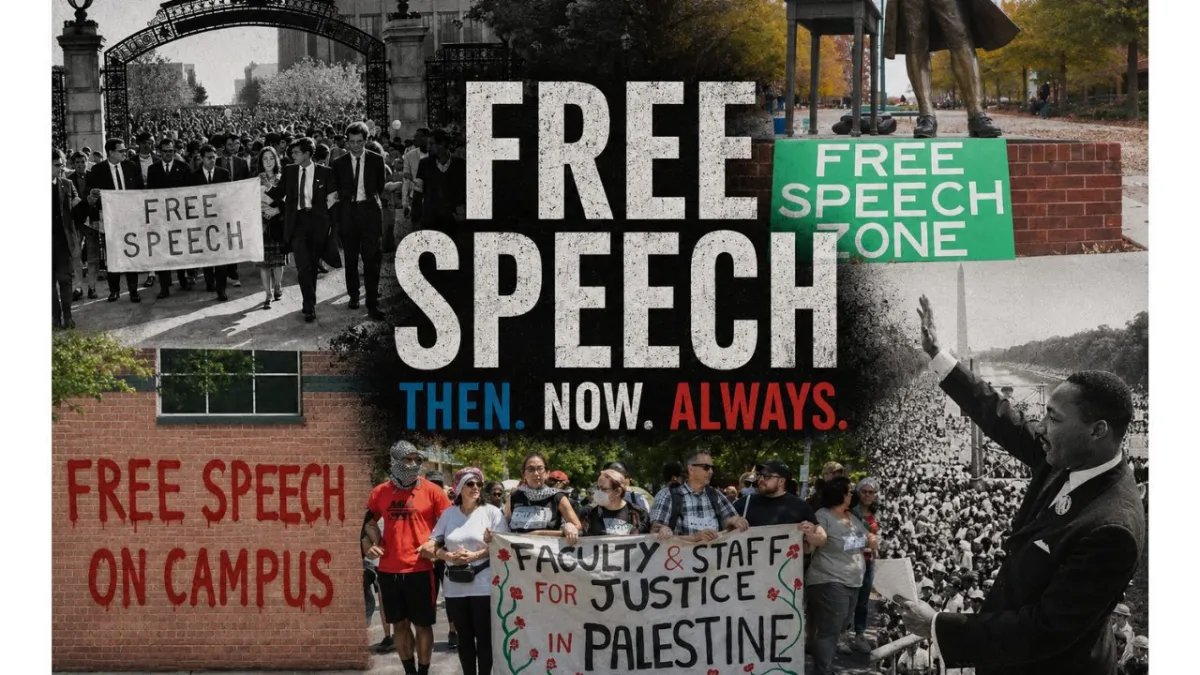
As the school year winds down on college campuses across the country, it seems clear that 2025-26 was not a great time for free speech in the academy, witness last month’s disruption of a speech by a member of the Trump Administration at the University of California, Los Angeles. This incident was just the latest evidence that “political tolerance among college students is declining.”
And, more important, as the year comes to a close, higher education’s understanding of free speech remains muddled. While colleges and universities frequently reaffirm their commitment to fostering a robust exchange of ideas, they just as frequently don’t deliver on that commitment.
Leaders of those institutions seem afraid to take a stand for free speech when it matters most for them to do so. They don’t want to provoke the Trump Administration, stir up student protests, stand up to students who disrupt speakers, get at cross-purposes with left-leaning faculty, anger state legislatures whose support they need, or offend alums.
So, they temporize and acquiesce to a situation in which open inquiry is compromised every day at their schools. More workshops on how to have difficult conversations, more exhortations about the importance of curiosity, and more high-minded but empty rhetoric won’t do the work needed to ensure that colleges and universities are hotbeds for the free exchange of ideas or exemplars of tolerance and respect for difference.
A report of the Bipartisan Policy Center is right to say that “because the president’s voice is often identified with the institution’s voice, no individual is better situated to encourage a culture of academic freedom and free expression than the president.” Freeing up speech on campus will take determined leadership by college and university presidents.
It will require presidents to work to ensure that no one will be hired to teach at the institutions they lead whose work is narrowly focused on advancing an ideological project and who is willing, as Harvard University’s Cass Sunstein puts it, to pay close attention “to the force of the particular argument(s)” they encounter.
As Sunstein observes, this isn’t about viewpoint diversity so much as it is about recruiting people who want to be in place where politics isn’t “front and center – not close,” a place where you can’t “predict” where faculty and students “would end up on new questions” and where “positions…(are) usually developed in the process of discussion, not taken in the first seconds.”
A little more than six decades ago, the so-called Free Speech Movement was born at the University of California, Berkeley. It was a student-led effort to pressure the university administration to allow student organizations to engage in political activities. New York University Professor Robert Cohen notes that Berkeley students “won a historic victory for student free speech rights after a semester of protest, including the most extensive use of civil disobedience on campus and the largest mass arrest (of more than seven hundred students) to that point in American history.”
Today’s Free Speech Movement is unlikely to come from such student agitation. It requires university leaders willing to fight a multi-front war against the Trump Administration and, at the same time, the forces of intolerance at work in classrooms, in lecture halls and in dormitories.
They must be willing to say directly and unequivocally that their faculty must do a better job of using their academic freedom in the service of the disinterested pursuit of truth, rather than to advance a political agenda, that their students need to shed their childlike desire to avoid confronting ideas they initially find repugnant, and that they will stand up to any external constituency that wants the institutions they lead to compromise free speech values.
As they undertake that work, college and university presidents should band together and make their new commitments visible to the public. They should build on work started in 2023, when 13 college presidents started “a coordinated effort across their campuses to support free speech.” They should pledge mutual assistance when students, faculty or others gang up on one of their number for acknowledging the deep-seated free speech problems that are suffocating campuses across the country.
Let me be clear. There is no one-size-fits-all solution to 2026’s free speech problems on college campuses. College and university presidents will have to navigate the distinct situations at their respective schools.
But they can and should endorse what the American Civil Liberties Union wrote in 2024 in an open letter to college and university presidents. That letter urged them to “fashion responses to the activism of your students (and faculty and staff)…that (do not) sacrifice principles of academic freedom and free speech that are core to the educational mission of your respected institution.”
The ACLU reminded college leaders “not (to) single out particular viewpoints — however offensive they may be to some members of the community — for censorship, discipline, or disproportionate punishment.” It added that “The rules must not only be content neutral on their face; they must also be applied in a content-neutral manner“ and urged “campus leaders… (to) resist the pressures placed on them by politicians seeking to exploit campus tensions to advance their own notoriety or partisan agendas.”
That is good as far as it goes. But threats to free expression and open inquiry happen every day in college classrooms across the country.
They are more subtle but more pervasive than those coming from the Trump Administration or from students who shout down invited speakers on campus. Unless college presidents address them, students will continue to feel that they are not free to say what they think in their classes and in their social lives, as demonstrated in a Harvard student survey.
At the same time that they take on the real threats to open inquiry from the Trump Administration, work for which there will be widespread support on campus. They need to acknowledge and address the things that their university does to “promote a campus culture that punishes contrarian ideas and pressures academics to endorse progressive political positions with which they may disagree,” a group of academics at the University of British Columbia urges.
That task will surely create conflict on campus and cause college presidents to lose friends among students, faculty, and staff. It will require courage, skill, and a cultivated understanding of what free speech and open inquiry entail.
They should recall, as Wesleyan President Michael Roth points out, that “speech is never absolutely free; it always takes place for specific purposes and against a background of some expression that is limited or prohibited…. We must beware of the rubric of protecting speech being used as a fig leaf for intimidating those with less power.”
But 10 years ago, the University of Chicago was also right when it told its incoming students in no uncertain terms that “You will find that…rigorous debate, discussion, and even disagreement… may challenge you and even cause discomfort.” It went on to say, “Our commitment to academic freedom means that we do not support so-called ‘trigger warnings,’ we do not cancel invited speakers because their topics might prove controversial, and we do not condone the creation of intellectual ‘safe spaces’ where individuals can retreat from ideas and perspectives at odds with their own.”
Editor’s Note: At a moment when the once vaunted model of responsible journalism is overwhelmingly the play thing of self-serving billionaires and their corporate scribes, alternatives of integrity are desperately needed, and ScheerPost is one of them. Please support our independent journalism by contributing to our online donation platform, Network for Good, or send a check to our new PO Box. We can’t thank you enough, and promise to keep bringing you this kind of vital news.
You can also make a donation to our PayPal or subscribe to our Patreon.
Please share this story and help us grow our network!
[ad_2]
Source link
