
[ad_1]
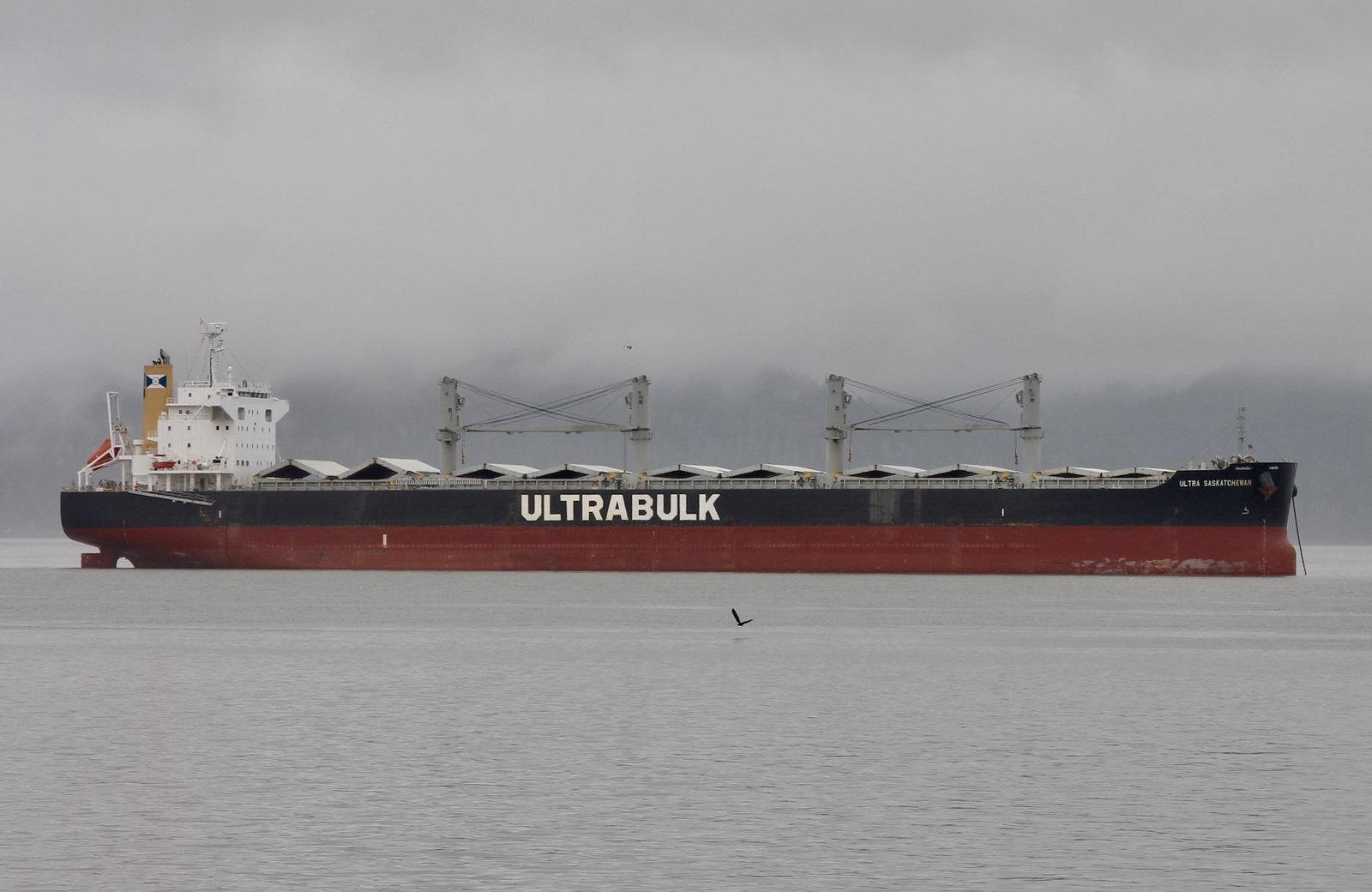
Ultrabulk transoceanic cargo ship, Columbia River. Photo: Jeffrey St. Clair.
The Trump administration is framing its barrage of sanctions announced on April 24, targeting the Hengli Petrochemical refinery in Dalian and 40 associated shipping entities, as a masterstroke of pre-summit leverage. As President Trump prepares to meet President Xi Jinping in the middle of May, the White House seems to believe that by tightening the financial stranglehold on China’s energy supply chains, the United States has secured a dominant position.
However, a cold assessment of the global maritime landscape suggests the opposite. Washington is attempting to use twentieth-century leverage against a twenty-first-century reality. In doing so, it has not created a bargaining chip. Rather, it has signaled a preference for “managed collapse” over a stable global order, inadvertently forcing Beijing to activate its most formidable deterrent: the Shipping Shield.
The administration’s logic rests on the assumption that global trade remains a Western-led system where maritime access is a privilege granted by American naval and financial hegemony. This assumption is increasingly decoupled from reality. For over a decade, Beijing has moved from a directional model of trade to a dimensional one. This is an integrated, redundant, and self-reinforcing global maritime system designed specifically to withstand the type of maximum pressure the Treasury Department is currently exerting. By sanctioning independent refineries and the “shadow fleet” of tankers, Washington is not disrupting a fringe element of Chinese commerce. It is attacking a system that has already built significant immunity to Western jurisdiction.
Consider the industrial foundation of this Shipping Shield. As of the first quarter of 2026, China’s dominance in shipbuilding has reached a point of structural concentration that the world has never seen. Chinese yards now account for over 55 percent of global shipbuilding output. In just the first two months of this year, deliveries surged by 38 percent year-on-year, even as global orders elsewhere fluctuated. This is no longer just about commercial market share. It is about sovereign resilience. China owns the means of production for the global fleet. In a world where 90 percent of trade moves by sea, the nation that builds the ships and controls the containers holds a veto power over global stability that transcends the reach of the U.S. dollar.
Furthermore, this industrial capacity is backed by a global network of port infrastructure that acts as a physical counter-sanction mechanism. From Piraeus in Greece to the logistics hub at Gwadar in Pakistan, Chinese state-owned enterprises manage or own stakes in over 100 ports across 50 countries. This is not the “debt-trap” narrative of years past; it is a sophisticated dual-layer architecture. While Western analysts focus on the Strait of Hormuz—where the United States has recently imposed a physical blockade—Beijing has spent the last decade fast-tracking the China-Pakistan Economic Corridor. The status of the CPEC in 2026 reflects a transition from construction to strategic optimization, providing a vital bypass that renders the “Malacca Dilemma” a relic of the past.
By applying these sanctions just weeks before the May summit, the Trump administration has effectively removed its own bargaining power. In the world of high-stakes diplomacy, the threat of a sanction is far more valuable than its execution. Once the financial stranglehold is applied to an entity like Hengli, which processes 400,000 barrels of crude per day, the target has no choice but to accelerate its integration into alternative, non-Western financial ecosystems. This is playing out in real-time as Beijing operationalizes new regulations. As China’s National Bureau of Statistics recently noted, the industrial sector has continued to post strong growth despite a complex economic environment, driven largely by high-end manufacturing and equipment.
This resilience is codified in recent legal maneuvers. On April 7, the State Council published Order No. 834, which establishes a unified, national security-driven framework for supply chain oversight. This framework provides Beijing with the legal and physical capacity to “blockade the blockaders,” creating a parallel maritime order that is structurally capable of sustaining Chinese commerce even under conditions of Western interdiction. The regulation allows Beijing to investigate any foreign organization that “interrupts normal transactions,” effectively turning the table on those who use commercial ties as a political weapon.
The broader strategic risk for the United States is the alienation of its own allies. European and Asian partners, who rely on the predictability of global shipping, view the “managed collapse” of energy markets with profound alarm. While Washington focuses on punitive measures, Beijing is positioning itself as the guarantor of maritime connectivity. These nations are not looking for a “grand bargain” that preserves American hegemony. They are looking for a system that functions.
When President Trump sits across from President Xi in May, he will likely find that the “sanctioned table” is not the position of strength he imagines. Beijing understands that its control over the nodes of global commerce—from the steel in the shipyards to the cranes in the ports—provides a level of protection that secondary sanctions cannot break. The Shipping Shield is a reminder that in 2026, power is not defined by the ability to stop the flow of goods, but by the capacity to ensure they continue to move.
If the United States continues to treat the global commons as a zero-sum battlefield, it may find that it has not cornered its rival but has instead isolated itself from the very infrastructure of the modern world. Washington’s current course does not lead to a better deal. It leads to a world where the United States is no longer the indispensable mariner.
This first appeared on FPIF.
[ad_2]
Source link
