
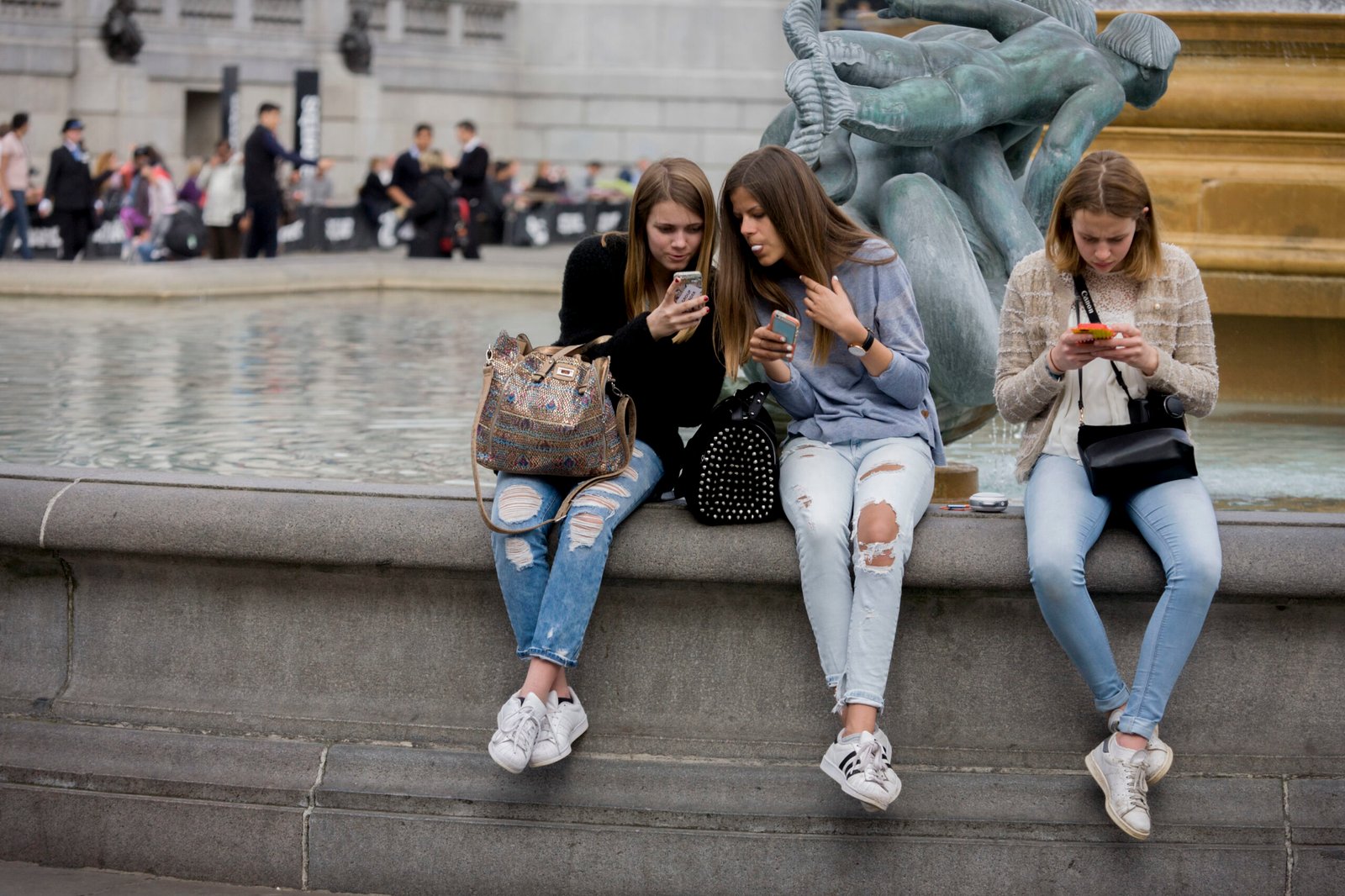
Painters think in brushstrokes. Directors think in scenes. Women under 30 think in Instagram stories. Young women’s travel, clothing, hobbies, and even their romantic relationships are subconsciously selected based on what would look best photographed, filtered, and ironically captioned. Digital life and real life are not in competition; they’ve melded.
Social media isn’t a hobby or a distraction for young women; it is their medium of self-creation and, in some instances, self-destruction—and it has ruined girlhood, Freya India writes in her debut book GIRLS®: Generation Z and the Commodification of Everything. India, herself a 20-something, surveys the online activity of young women in the United States and United Kingdom to issue a dire warning: Girlhood as we know it is over. The oldest women of Generation Z are turning 30 after spending their teenage years toggling between Tumblr and Twitter. India cites statistic after statistic showing that the kids are not all right, such as a 2022 survey that found that around 37 percent of U.K. teens ages 12 to 18 had been prescribed antidepressants at some point in their lives. Girls have “always felt anxious, insecure, and unsure,” but modern life has amplified these feelings to an untenable level, India writes.
A combination of corporate greed, family breakdown, and therapy culture has turned girlhood into a minefield, and the generation of women that have emerged are utterly broken and, India seems to imply, less human. India hits all the expected notes—she makes references to Euphoria, OnlyFans, and Christopher Lasch’s The Culture of Narcissism—but the arguments in GIRLS® fall flat not because India’s thesis is wrong but because she overstates the problem.
Yes, it seems that something is off when young men are more likely than young women to want children, or when headlines declare young people are in a “dating recession.” But India flattens the Gen Z experience into a monolith: “We never had places to practice being good people… We had so few opportunities to practice selflessness. No neighbors to try kindness with. No bonds we couldn’t easily break. No obligations to learn loyalty. We grew up in a world of strangers, with so few expectations of each other, so little accountability.” Might I say—not all zoomers?
Most members of Generation Z are no longer teenagers. I’m a so-called elder Zoomer—born in late 1997—and I have an SUV, a mortgage, and two children. Like many women my age, I know next to nothing about today’s TikTok trends or Twitch streamers. But unlike many women of my generation, I didn’t get a smartphone until I went to college. I came of age just as the tide was turning from play-based to phone-based childhood, as author Jonathan Haidt puts it in his book The Anxious Generation, which focuses on young adults’ mental health issues.
Haidt is one of the scholars at the heart of the iPhone wars, and India is his protégé, having written for his site After Babel. Haidt and his allies say that data shows that the advent of the iPhone has ushered in societal decline. Haidt’s critics say he is standing in the way of progress and freedom. Reason accuses him of “bad science,” and the Guardian says the first half of The Anxious Generation “reads as sensational generalization.” It is into this fray that India jumps, zeroing in on what she and her peers have experienced. Gen Z is now old enough for us to observe how adolescent social media use has affected them in adulthood, and India divides her observations into six sections: “Filtered” covers how social media made girls hate how they look; “Diagnosed” covers how social media companies pushed girls to make mental health issues part of their identities; “Documented” covers how girls began living life for approval on social media; “Disconnected” covers how the breakdown of family and community has affected girls; “Detached” covers how social media has warped gender relations; and “Empowered” covers what value systems have filled the vacuum as religion fades from Western life.
“Empowered” is the last section of the book, and none of the other sections make sense without it. Instead of Christianity, Gen Z women have manifesting, therapy, and social justice activism. India identifies Gen Z as the “least religious generation in history” but stops short of recommending returning to organized religion en masse as a possible solution for their problems.
“I think we need to find faith. Not necessarily religious faith but faith in something more,” India writes. She doesn’t identify herself with any religion, and Haidt identifies as an atheist, which gives an interesting flavor to their moralizing—under what moral system are they operating, exactly? Haidt can’t escape biblical imagery—the name of his Substack, After Babel, comes from Genesis 11, and Haidt describes the Tower of Babel as “the best metaphor I’ve found for making sense of the momentous sociological, cultural, and epistemological changes that occurred in many nations in the early 2010s.” Perhaps the solutions Haidt and India search for are right under their noses.
The big question that India tries to answer is whether the problems Gen Z girls face are on par with what other generations of girls have faced, or whether something far worse is happening. Gen Z has been decried for being too sensitive, needing safe spaces and trigger warnings. In 2022, author Paul Fairie’s post called “A Brief History of Kids Today Are Too Soft” went viral on X-formerly-known-as-Twitter. Fairie cited newspaper stories handwringing about “kids these days” from 1921, 1931, 1942, 1955, 1961, and on and on. The collective response was a virtual wiping of the brow while uttering, “Phew!” If past generations also called youngsters “too soft,” then surely Gen Z would emerge into adulthood unscathed, too.
India doesn’t buy that logic. “What girls and young women are going through today is something new,” she writes. “We see this most clearly in the complete collapse of their mental health. Since the early 2010s, Generation Z—those of us born between roughly 1996 and 2011—has been falling apart, with adolescent girls hit hardest.” If Haidt’s and India’s detractors are correct, then the challenges Gen Z girls are experiencing will have solutions that don’t require society-wide solutions. The girls just need to get through it. But if Haidt and India are correct, then society must be reordered on a multitude of fronts, from how students learn to how corporations advertise.
As its subtitle suggests, GIRLS® is about the “commodification of everything.” Corporations marketing to teens and 20-somethings is nothing new—but having almost 24/7 access to their young customers’ attention, data, and insecurities is. In The Culture of Narcissism, published in 1979, Lasch said the advertising industry “flatters and glorifies youth in the hope of elevating young people to the status of full-fledged consumers in their own right, each with a telephone, a television set, and a hi-fi in his own room.”
If only he had seen Instagram. Social media is the ultimate selling machine, and much of its power comes from the parasocial relationships that consumers have with influencers. What are parasocial relationships? They’re “one-way, screen-mediated, ersatz intimacies,” as Eddie LaRow puts it in First Things. And they’re worth a lot of money to brands. Influencers convince women that their teeth aren’t white enough, their hair isn’t soft enough, or their body isn’t attractive enough, and then they provide links to the exact product their followers must buy to fix these problems they didn’t know they had.
The “bestie-fication” of influencers is part of that power. “By being vulnerable with their ‘besties,’ influencers rack up views. By encouraging comments from their ‘friends,’ they boost engagement. And by sharing solutions and discount codes with their ‘family,’ they earn commissions,” India writes.
India’s points about how influencer culture encourages girls to think of themselves and others as products are probably the strongest in the book. “Social media teaches us to each see ourselves as individual profiles, rival brands, competing products,” she writes. “This is the most painful part of looking back at my own girlhood, the realization that we weren’t simply turning into products. We were being trained to treat each other like products, too.”
Throughout the book, India gives us glimpses of her girlhood but never enough for a detailed picture. We learn that her parents divorced when she was young, that social media was a big part of her adolescence, and that it’s something she’s now come to view as not only a waste but a harm. India is the only recurring character in GIRLS®; in every section of the book, she quotes girls’ posts and videos to illustrate her points but rarely returns to them. By choosing not to interview any of the influencers or posters she quotes and relying only on what they put online, India undercuts her own argument that the Internet is not real life. If social media distorts everything it touches, and everything a girl says or does online is not necessarily an expression of her true self but a way of packaging her personal brand, then why doesn’t India dive deeper into what these girls were thinking and feeling when they made these posts? The book is more of a survey of what’s being said online rather than a holistic look at how Gen Z women are developing. She summarizes TikTok videos and Reddit posts on topics like pornography and social anxiety, but the reader never learns what motivated the unnamed social media users to post about their challenges or whether they overcame those challenges.
Subscribe Today
Get daily emails in your inbox
GIRLS® was released in India’s native U.K. in February 2026. Her fellow Brit Louis Theroux released his documentary Inside the Manosphere via Netflix a few weeks later. Inside the Manosphere touches on many of the same themes as GIRLS®: the attention economy, the breakdown of the nuclear family, and hyperreality. Unlike India, Theroux meets the people behind the posts. He interviews so-called redpill influencers in their daily lives, inviting the viewer to see past the machismo and recognize that each muscled, manly social media star is really just a little boy from a broken home. India chose to focus on girls at a time when it’s more fashionable to worry about boys and their diminishing expectations, but it’s naive to think that men’s and women’s problems are discrete issues. One redpill influencer interviewed by Theroux, Harrison Sullivan (alias HStikkytokky), promotes OnlyFans actresses on his platform but says he personally thinks porn is bad for men. Theroux tells him that his decision to promote OnlyFans is like inviting a friend to work out at the gym and then meeting him at the door with a dozen donuts. Sullivan says it’s not his fault if his followers get addicted to porn—they should have resisted the donuts. His response smacks of the narcissism that Lasch says is endemic to our culture.
This theme, responsibility, is woven into both the manosphere documentary and India’s book. Throughout GIRLS®, India lists all the harms that Gen Z girls had done to them, but she seems unsure of what the consequences of these harms should be. “The very companies that hollowed out our friendships have the nerve to sell us their substitutes,” she writes. Who let the companies do this hollowing? Are corporations solely responsible for the hollowing out of community in the Western world? It’s hard to blame Gen Z’s parents—the pace of technological and cultural change has been so fast. Paradoxically, parents en masse didn’t create the problem, but they must create the solution. As Clare Morell wrote in her 2025 book The Tech Exit: A Practical Guide to Freeing Kids and Teens from Smartphones, parents are the linchpin. In addition to setting habits at home, they can influence state legislators and school board members. Morell interviews parents who intentionally raised their children tech-free and couldn’t imagine life any other way.
India doesn’t offer many solutions for Gen Z women who feel social media harmed their development (besides an underbaked plea for readers to consider “sincerely trying to be good,” the kind of thing Lasch would have called a “superficially optimistic” hymn to growth), but if there is one takeaway for readers of both books, it’s that parents must go against the cultural grain. Parents can’t assume educators know best when they tout trading textbooks for Chromebooks. Parents can’t assume that Meta’s Instagram Teen Accounts are anything but a savvy marketing gimmick. GIRLS® contains some solid insights into the information overload aimed at the average twenty-something woman, but there’s still an opening in the market for a book that tells the real, raw story of what happened to Gen Z.
