
[ad_1]
In one of the scariest moments in modern history, we're doing our best at ScheerPost to pierce the fog of lies that conceal it but we need some help to pay our writers and staff. Please consider a tax-deductible donation.
Juan Cole For Informed Comment
\Although Asian economies have been the first to feel the cut-off in petroleum from the Strait of Hormuz, China has so far weathered the resultant energy crisis.
In fact, China’s economy grew at an annualized rate of 5% in January – March, and industry hummed along even more vigorously in April than it had in March. Ironically, some of the country’s increased economic vigor is from foreign demand for its solar panels and electric cars, spurred by the spike in crude and gas prices.
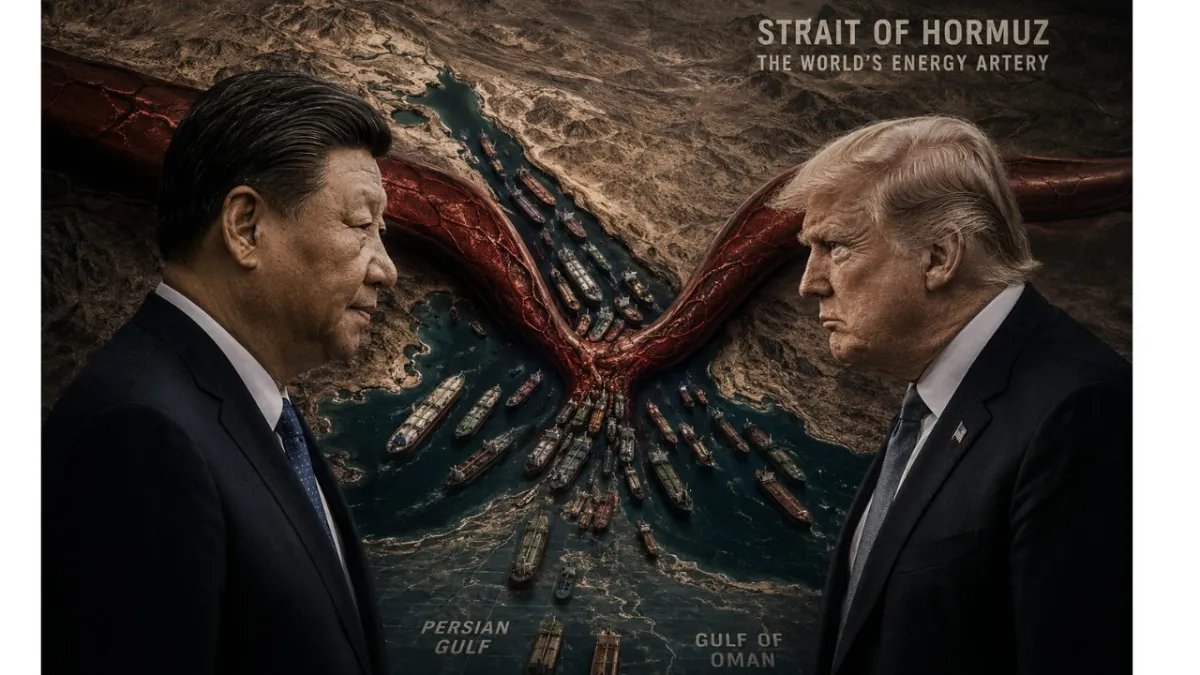
Still, as Trump heads off to Beijing next week, opening the Strait will be high on the agenda of Xi Jinping, since a global energy crisis is looming that could hurt the world economy and therefore China’s.
Two kinds of hydrocarbons are affected by the closure of the Strait of Hormuz, fossil gas and crude oil. China produces the majority of the fossil gas it uses, and it imports some of its needs by pipeline from Russia and Central Asia. Another portion is brought in by tankers in the form of Liquefied Natural Gas, with Qatar and Australia being the two biggest suppliers. Qatar closed off its fossil gas spigots on March 2, soon after the Israelis and the United States launched their unprovoked war of aggression on Iran.
China imports about 24% of its LNG needs from Qatar, which comes to 16% of its total fossil gas imports if we include imports by pipeline.
The shortfall in gas imports cannot be made up. Australia and the US are already producing at capacity. This shortfall potentially affects three sectors: 1) power generation, 2) urban heating and cooking and industrial processes like smelting, and 3) fertilizer (fossil gas provides the feed stock for the latter). In India, restaurants are already closing because of lack of cooking gas. Things haven’t gotten that bad yet in China.
China can easily replace the gas power plants with renewables, since it has gigawatts of new solar and wind, some of which is still not even connected to the grid..
But until urban heating, cooking, and factory processes like kilns are electrified, the gas shortfall will eventually hurt. It hasn’t yet, since some LNG was still on the water and being delivered until recently. If the fossil gas shortage continues into the winter, it will pose a problem for urban residents, since gas heating in apartments and factories cannot quickly be converted to run on other forms of energy. I suppose you could run an electric space heater off of China’s renewables.
As for the gasoline and diesel produced from crude oil, they have risen in price, from the equivalent of $4.16 a gallon in April to about $5 a gallon today. The lower grade of gasoline was the equivalent of $3.69 per gallon in February.

Still, China has some cushions with regard to petroleum. It produces about a quarter of the oil it uses. It can increase imports from Russia. It has six months of oil reserves, and anyway 53% of new car purchases are electric, a percentage that is likely to rise substantially this year.
Although China’s government has set the country up to be resilient to energy shocks, in a way that South Korea, say, has not, there are limits to what it can endure before slowing down. For one thing, if the Strait of Hormuz impasse continues for several more weeks, it will result in absolute shortages of oil and gas globally, provoking a slowdown of the world economy. Since China is the workshop of the world, selling everything to everyone, if people cut back on their purchases, China will take a big hit.
Juan Cole is the founder and chief editor of Informed Comment. He is Richard P. Mitchell Distinguished University Professor in the History Department at the University of Michigan He is author of, among many other books, Muhammad: Prophet of Peace amid the Clash of Empires and The Rubaiyat of Omar Khayyam. Follow him on Twitter at @jricole or the Informed Comment Facebook Page
Editor’s Note: At a moment when the once vaunted model of responsible journalism is overwhelmingly the play thing of self-serving billionaires and their corporate scribes, alternatives of integrity are desperately needed, and ScheerPost is one of them. Please support our independent journalism by contributing to our online donation platform, Network for Good, or send a check to our new PO Box. We can’t thank you enough, and promise to keep bringing you this kind of vital news.
You can also make a donation to our PayPal or subscribe to our Patreon.
Please share this story and help us grow our network!
[ad_2]
Source link
