
[ad_1]

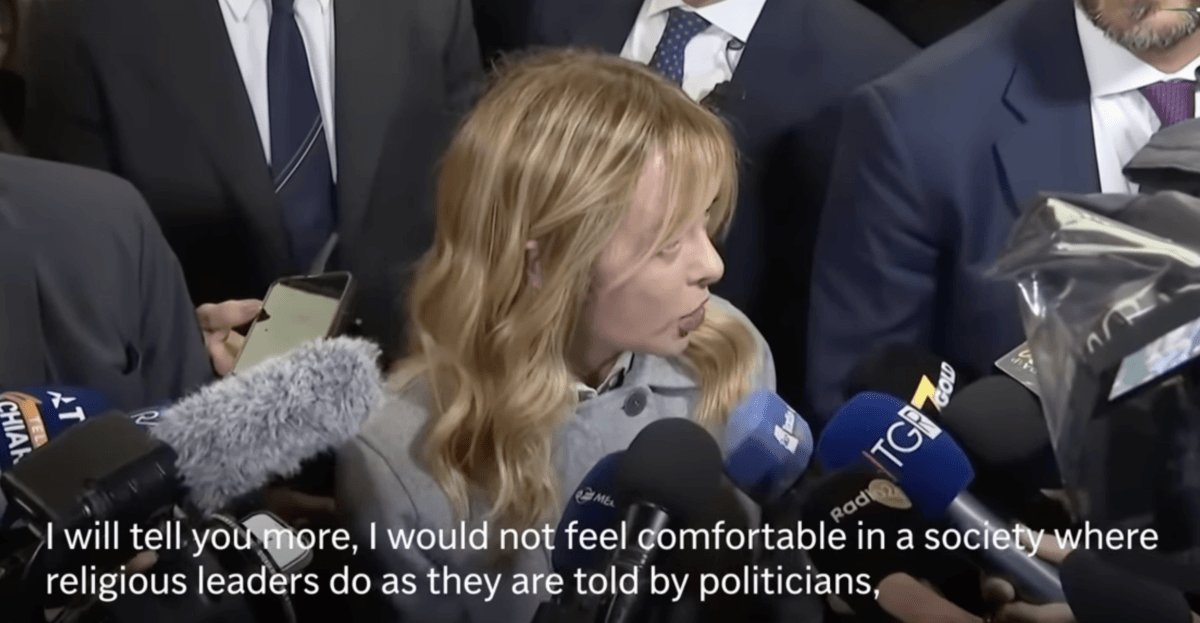
Hard right Italian Prime Minister Giorgia Meloni denouncing Trump’s attacks on Pope Leo. (Screengrab from video posted to YouTube.)
Donald Trump’s second term in office has been a disaster for U.S. national security, European security, and the entire international scene. Trump’s war with Iran has led to the use of thirty-thousand pound bombs and the closing of the Strait of Hormuz; his complicity with Israel has allowed Benjamin Netanyahu to pursue a genocidal campaign in Gaza and Zionist expansionism in southern Lebanon and southern Syria; and the displacement of Palestinians on the West Bank—a continuation of the Nakba from 80 years ago. His trade and tariff policies have backfired in every way, and even his Supreme Court has been resistant. Trump’s phony charges of a genocide against white farmers in South Africa is designed to appeal to Christian nationalists in his MAGA tribe at home.
Initially, European leaders tried to humor Trump, and to bring gifts of praise to the White House. Not even Trump’s ugly handling of Volodymyr Zelensky’s visit to Washington last year brought a change in European truckling toward Trump. However, the unfortunate alliance between the United States and Israel to conduct an illegal and immoral war against Iran has marked a turning point. The fact that no European leader was consulted or even warned in advance of the U.S.-Israeli bombing campaign was the last straw for the Europeans.
In many ways, King Charles’s lapidary speech to the Joint Session of Congress last week set out the European case against U.S. policies at home and abroad. The King was critical of the derogation of checks and balances in the U.S. political system and warned Trump not to ignore the climate crisis. Regarding U.S. foreign policy, the King reminded Trump of the importance of the Atlantic Alliance, the North Atlantic Treaty Organization, and U.S. relations with the European Community. The speech may have been too nuanced and sophisticated for Donald Trump, but the print media in the United States and Europe clearly understood the King’s message.
Key European nations have already taken steps to deal with their national security challenges without having the United States on their side. The defeat of Victor Orban in Hungary opened the door to a $107 billion European loan to Ukraine. The European defense industry has begun rapid revitalization, increasing investment to bolster defense production and to initiate a European Defense Industrial Strategy. There will be less reliance on U.S. suppliers and greater coordination among major European manufacturers to integrate AI and enhance unmanned systems. European defense spending has increased significantly over the past several years, and has reached $400 billion dollars, nearly doubling Russian defense spending.
Last week’s announcement from the Trump administration to withdraw 5,000 U.S. troops from Germany, its largest European base, worsened the feud between Donald Trump and German Chancellor Friedrich Merz. Even Republican leaders in the Congress understand that the step of withdrawal is a gift to Russian President Vladimir Putin that will not be reciprocated. Trump was responding to Merz’s criticism of Trump for “miscalculating” the Iranian situation and the threat of a nuclear Iran. Merz told a German audience last week that the United States “clearly” had no “strategic plan” in the war with Iran, and was being “humiliated” by Iran’s Revolutionary Guards.
France’s Emmanuel Macron and Italy’s Giorgia Meloni have also angered Trump with their calls for European “strategic autonomy” in defense. Macron now claims that the European Community’s mutual assistance clause (Article 42) is “stronger” than NATO’s Article 5 because it mandates “binding” mutual assistance. He also has questioned the reliability of the alliance with the United States. Meloni also favors increased defense cooperation in Europe, and has suspended defense agreements with Israel. Her steps represent a remarkable turnaround from last year, when she expressed skepticism about becoming a key European leader.
In addition to strengthening the cooperation in European defense industry, East and West European states are taking important steps to meld their intelligence and security agencies. Key European states are cooperating on intelligence analysis (EU INTCEN), cybersecurity (ENISA), and border security (FRONTEX) to deal with a greater Russian threat. There is greater cooperation on intelligence sharing, particularly regarding the Russia challenge and terrorism. An Intelligence College in Europe has been created to foster a shared strategic culture among European intelligence communities.
The latest U.S. National Security Strategy urged Europe to assume primary responsibility for its defense and anticipated a reduced American military footprint. It is clear that the Europeans have gotten the message and have taken the necessary steps to enhance its conventional defense. As long as the Europeans view Russia as a long-term adversary that could lead to sustained confrontation, it will be difficult to rebuild the U.S. alliance with Europe during the remaining years of Trump’s second term and possibly in the near future as well.
[ad_2]
Source link
