
[ad_1]
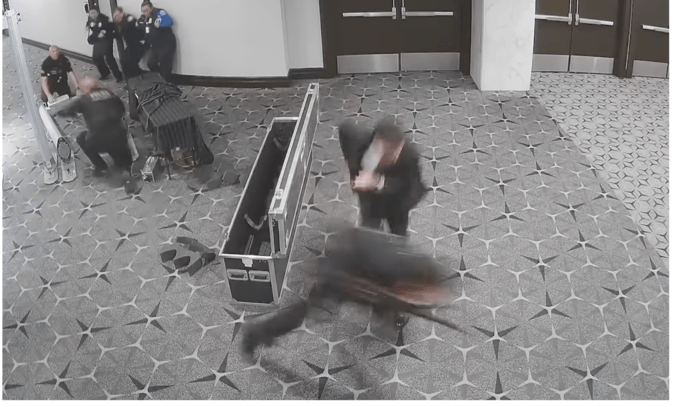
Armed assailant (Cole Tomas Allen) sprinting through supposed secure area, Washington Hilton, April 25, 2026, FBI Field Audio/Video.
Bad assassins
In a recent conversation, a friend and I casually discussed, as one does, the declining skills of American presidential assassins. In the first two hundred years (roughly) after the nation’s founding in 1776, we noted, there were nine attempts, four of which were successful – Lincoln, Garfield, McKinley, and Kennedy (44%). Since that time, there have been seven attempts, none successful (0%). The most obvious reason for the decline is improved presidential protection.
But given the many demonstrable failures in security, that doesn’t seem the best explanation. Lynette “Squeaky” Fromme, shot at Gerald Ford from point blank range; she only failed to hit him because she didn’t properly cock her pistol. Just two weeks later, Sara Jane More also shot at Ford, this time from 40 feet away; she missed and a civilian grabbed her gun and subdued her before she could fire a second round. In 1981, John Hinkley was just ten feet from Ronald Reagan when he squeezed off six shots. All missed their targets, though one ricocheted and struck Reagan in the lung, seriously injuring him. In each case, the Secret Service deserved a grade of F.
The two assassination attempts in 2024 came when Trump was a candidate, not president, so they don’t count in our tally. Nevertheless, it’s worth noting that the Thomas Mathew Crooks attempt could be called a comedy of errors, if it weren’t for the tragic death of an innocent bystander and the killing of Crooks himself. The would-be assassin fired eight shots from an AR-15 rifle using a red dot sight. Those sights are not telescopic and thus significantly less precise from long distances. Crooks made a rookie error in choosing the wrong equipment. The Secret Service also performed badly. They failed to spot the shooter early, while he was casing the premises, and allowed Crooks to establish a clear sightline from the roof of a nearby building. Rounds flew everywhere, and Trump was apparently struck on the ear by a bullet fragment, though that remains contested.
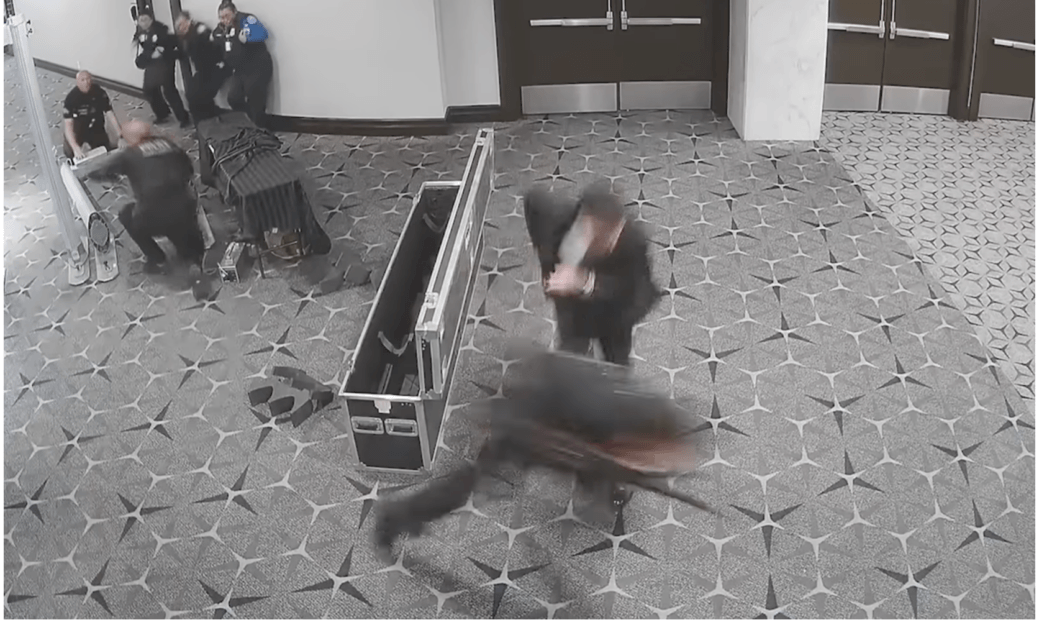
Video of the attack two weeks ago at the White House Correspondent’s Dinner shows no less than eight police and Secret Service officers and one sniffer dog standing around a dismantled magnetometer while the would be shooter, Cole Tomas Allen, dashed toward the ballroom. Five shots were fired at him; none hit their mark, though one may have struck another agent. The knives and shotgun Allen carried (in addition to his pistol) are useless for the purpose of modern-day presidential assassination and only slowed him down. Like Crooks, Allen was poorly prepared for his job, and it was only the ineptitude of police and Secret Service officers that allowed him to get as far as he did. He was apprehended after tripping over a box, or getting tangled up with his own shotgun, a Mossberg 88 Maverick, just outside the auditorium. (As it happens, when I lived in Florida, I owned this model of shotgun. It’s cheap and heavy and I wouldn’t want to run with it. I fired it exactly twice, at a helpless tree stump ten feet away, and missed both times.) More information may emerge to change our understanding of Allen’s planned attack. It could have been an attempted suicide by cop rather than assassination. If so, the cops who couldn’t shoot straight let Allen down.
It’s unclear why the assassins in the cases above performed so poorly. The most likely explanation is that their acts were expressions of narcissism or grandiosity rather than principle. They wanted to be seen, apprehended or perhaps even killed. That isn’t true for the assailants of Lincoln, Garfield, McKinley or Kennedy. In each of those cases, the assassin was motivated by political or moral enthusiasm, however misguided. Successfully killing a president, in short, requires the discipline born of overpowering conviction. That’s why it’s rare in the contemporary U.S. Most of us are glad for that fact; a few are unhappy about it; fewer still will openly admit the latter sentiment.
Assassination law
Assassinating the president is a crime under federal statute 18 U.S. Code § 1751. The same law forbids assassinating, kidnapping or assaulting the Vice-President or anyone in line to become president following the office holder’s death or incapacity. There is also a law, 18 U.S. Code § 871, that protects the president, vice-president, etc., against threats of death, kidnapping or other bodily harm. These laws are in addition to other state and federal or state laws against murder, kidnapping, assault, threats of violence and all the rest. In sum, it’s safe to say, assassinating, assaulting or threatening a U.S. president is and always has been, everywhere illegal.
There is however, no law forbidding the president or other agents of the U.S. government from assassinating another head of state or officer in the line of succession. There is instead an Executive Order (E.O. 12333 § 2.11), issued by President Ronald Reagan in 1981 that states: “No person employed by or acting on behalf of the United States Government shall engage in, or conspire to engage in, assassination.” The directive, like U.S. laws against domestic assassination cited above, makes moral and practical sense. According to the philosopher Emanuel Kant’s “categorical imperative,” any rights we assert for ourselves as rational beings must be granted to other rational persons, or else our own claims are hollow. Just as the U.S. abhors assassination of its highest ranked officials – there’s no clearer affront to popular sovereignty than murdering an elected leader – so must it abjure the assassination of another country’s leader. That’s notwithstanding the quality of the process by which the foreign leader was selected. When it comes to democracy, the U.S., with its Electoral College, gerrymandered districts, and unlimited corporate spending on elections, can hardly tell other nations how to select their presidents, prime ministers or ayatollahs.
Nevertheless, Executive Order 12333 has been violated numerous times by the current occupant of the White House. Previous presidents too have plotted or approved assassinations of foreign leaders. The U.S. and CIA were responsible (directly or indirectly) for the killings of Congolese Prime Minister Patrice Lumumba, Dominican President Rafael Trujio, and Chilean President Salvador Allende. American officials tried on many occasions to kill Cuban President Fidel Castro. The U.S. military, under the direction of President Trump, carried out the assassination of Iranian Ayatollah Ali Khamenei and other national leaders. These killings violate EO12333 but are not prosecutable under federal law. An EO is not a law, just a directive to officers and employees of the executive branch. Moreover, a president can at any time overturn or suspend a previous executive order or do so retroactively without legal consequences.
Even if codified in law by Congress, EO12333 would be unenforceable against the U.S. president because of the Supreme Court’s ruling in Trump v. United States (2024) that the president has “absolute immunity” from criminal prosecution for all “official acts.” That almost certainly includes assassinating a foreign head of state.
“Seditious libel” and “imagining the king’s death”
If Trump has his way, everything written in the paragraphs above would be legally proscribed, indeed prosecutable. That’s because he seems intent on restoring colonial-era, that is, Georgian laws banning “seditious libel”, and “imagining the king’s death.” The first means defamation of the head of state, a harm which Trump claims often to have suffered. He’s brought defamation suits again ABC, CBS, BBC, CNN, the Wall Street Journal, The New York Times, and the Pulitzer Prize Board. He has also charged Senator Mark Kelly, Representative Elissa Slotkin and four other Democratic legislators with criminally “seditious behavior” after they released a video advising members of the military they could (indeed must) refuse “illegal orders.” Trump said that such counsel was “punishable by DEATH.”
Seditious Libel was a crime under English common law, clarified by the Court of Star Chamber in the early 17th century. It made it a crime to bring the king, government or church into “hatred or contempt.” Until around 1700, it was rarely enforced because there existed a surfeit of other, easier to prosecute laws against treason and heresy – as well as licensing regulations — that enabled the state to limit any spoken and written language it deemed offensive. But after the loosening of publication rules in the 1690s and the rise of a freer press, the law of seditious libel was adapted to meet the needs of the king and his ministers.
By the 1790s, when the American and French Revolutions challenged the political and economic hegemony of the British state, the law against seditious libel was repeatedly deployed to prevent the publication of radical tracts and punish their authors. The latter included Thomas Paine (author of The Rights of Man), publisher Joseph Johnson, bookseller James Ridgway, radical pamphleteer Thomas Spence, and even the poet and artist, William Blake. The last more accurately, was charged with using “seditious words” for allegedly saying, “Damn the king,” “the soldiers are all slaves,” and “If Bonaparte should come, he [a soldier who trespassed Blake’s property] would be cut to pieces, and so would the [other British] soldiers.”
It’s unclear if Blake uttered these exact phrases, though he did write in a private notebook, “Everybody hates a King.” He was fortunate, at his trial in Chichester in 1804, to have a good lawyer, an incompetent prosecutor, and a sympathetic jury; faced with transportation to Australia or an even worse punishment, he was acquitted. Others, like Ridgway, Johnson and Spence were convicted and sent to prison for various lengths of time. The law of seditious libel was only removed from the criminal code in 2009.
In addition to claiming to have been seditiously libeled, Trump has also charged that former FBI Director James Comey and TV talk-show host and comedian Jimmy Kimmel threatened him with death. Comey was recently indicted by a D.C. grand jury for making
a threat to take the life of, and to inflict bodily harm upon, the President of the United States, in that he publicly posted a photograph on the internet social media site Instagram which depicted seashells arranged in a pattern making out ‘86 47’, which a reasonable recipient who is familiar with the circumstances would interpret as a serious expression of an intent to do harm to the President of the United States.
When accused last year of threatening the president’s life Comey expressed surprise, stating that he did not intend to “do harm” to the president. He nevertheless apologized for any unintended offense and removed the postings. (The origins of the term “to 86” are obscure, but by the 1950s, it was widely used in the hospitality industry to mean either that an item on a restaurant menu was no longer available, or that a drunk or unruly customer needed to be banned or removed. Trump is the 47th president.)
Kimmel was attacked by the White House for a monologue in which he pretended to see Melania Trump in his studio audience: “Our First Lady, Melania, is here. Look at Melania, so beautiful. Mrs. Trump, you have a glow like an expectant widow.” The joke, presumably about the 23-year age difference between husband and wife, was made before the recent assassination attempt. A few days after, White House communication director Steven Cheung said Kimmel was a “shit human being” for his “disgusting joke about assassinating the President”. White House Press Secretary Karoline Leavitt said “”Who in their right mind says a wife would be glowing over the potential murder of her beloved husband?” Trump himself called for Kimmel to be fired by his employer, ABC/Disney.
There have so far been no charges brought against Kimmel, though it’s early days. (The Comey indictment came a year after the alleged offense.) Any criminal case would presumably be based upon the same law, 18 U.S. Code § 871 used to indict the former FBI Director. In both cases, the statute would have to be construed to mean “imagining the king’s death,” since there was no overt act or even direct threat.
The English Law of Treason of 1351 (25 Edward III, c. 2) states that it is an offense of treason:
When a man doth compass or imagine the death of our lord the King, or of our Lady his Queen, or of their eldest son and heir […] and thereof be provably attainted of open deed by the people of their condition.
When first passed, the statute reduced arbitrariness in the prosecution of treason. But in subsequent centuries, it became a vehicle precisely for the sort of arbitrariness and caprice it was supposed to reduce. By the age of George III (Trump’s only true predecessor in American politics), the law was invoked in all major treason trials. It was useful because it required no proof of actual violence or even a plot of regicide – simply the imagining or “compassing” of such a thing. The words in the statute “provably attained by open deed,” mean only that observed deeds may be needed to achieve a conviction. The true offense was the thought crime of “imagining” and “compassing” the king’s death.”
The indictment of Comey and the invective against Kimmel are efforts to criminalize or police thought. The fact that thoughts, even treasonous ones, can’t be easily be suppressed, is irrelevant when the goal is to create an atmosphere of repression and control. Nor does it matter that the prohibition against imagining the king’s (or the president’s) death is self-contradictory – any such prosecution must itself entail imagination of the ruler’s death, and thus a crime. These paradoxes are not bugs in the legislation, but, features. The goal once more, is to inhibit free thought and promote a widespread and debilitating paranoia.
“Dead Presidents”
Dead presidents are frequent subjects of American literature. Novels featuring plots against living presidents include Richard Condon’s The Manchurian Candidate (1959), Stephen King’s The Dead Zone (1979), and the same author’s 11/22/63 (2011), Nicholson Baker’s Checkpoint (2004) and Jonathan Freedland’s To Kill the President (2017). There are more movies about the subject than I care to count.
In 1959, blues musician, composer and producer Willie Dixon wrote a song titled “Dead Presidents” It was recorded four years later by blues singer and virtuoso harmonica player Little Walter. It begins:
Them dead presidents
Them dead presidents
Well I ain’t broke but I’m badly bent
Everybody loves them dead presidents
Like many Chicago blues songs, it’s about money: the aching pain felt from lack of it, and the fantasies of freedom from its attainment. Each verse of the song describes a higher currency denomination, and what it can or can’t buy you. Lincoln (on a penny) can’t even park your car, but Jefferson on a two-dollar bill can bring you success at the track and maybe allow you to “bring sone big bitch back.” Grant on a fifty, “a poor man’s friend, will get you out of whatever you are in,” meaning you can use it to pay a debt, bribe, fine or possibly arrange bail. The song culminates with celebration of McKinley and Cleveland on $500 and $1,000 bills (these are no longer in circulation).
Another song with the same title was recorded in 1996 by rapper and producer Jay-Z. It was the first single released to promote his debut album, Reasonable Doubt. This song too is about the money dreamed by poor Black men:
I’m out for presidents to represent me (Get money)
I’m out for dead nikcuf [fuckin’) presidents to represent me….
Live out my dreams ‘till my heart give out.
For Little Walter and Jay-Z, the only American presidents they care about are “dead presidents,” the ones that appear on paper currency. Jay-Z has gone on to collect a lot of them. Married to Beyoncé, and widely described as a rap-mogul, he’s the wealthiest musician is history, worth more that $2.5 billion. He and Beyoncé (worth $1 billion) and their daughter appeared last week at the Met Gala, an event sponsored this year by Jeff Bezos, the world‘s second or third richest person with wealth totaling about $230 billion. The city beyond the Met has a poverty rate of 25%, and a homeless population of more than 100,000. President Trump might not want to hear about it, but there’s nothing more American than dead presidents.
[ad_2]
Source link
