
[ad_1]
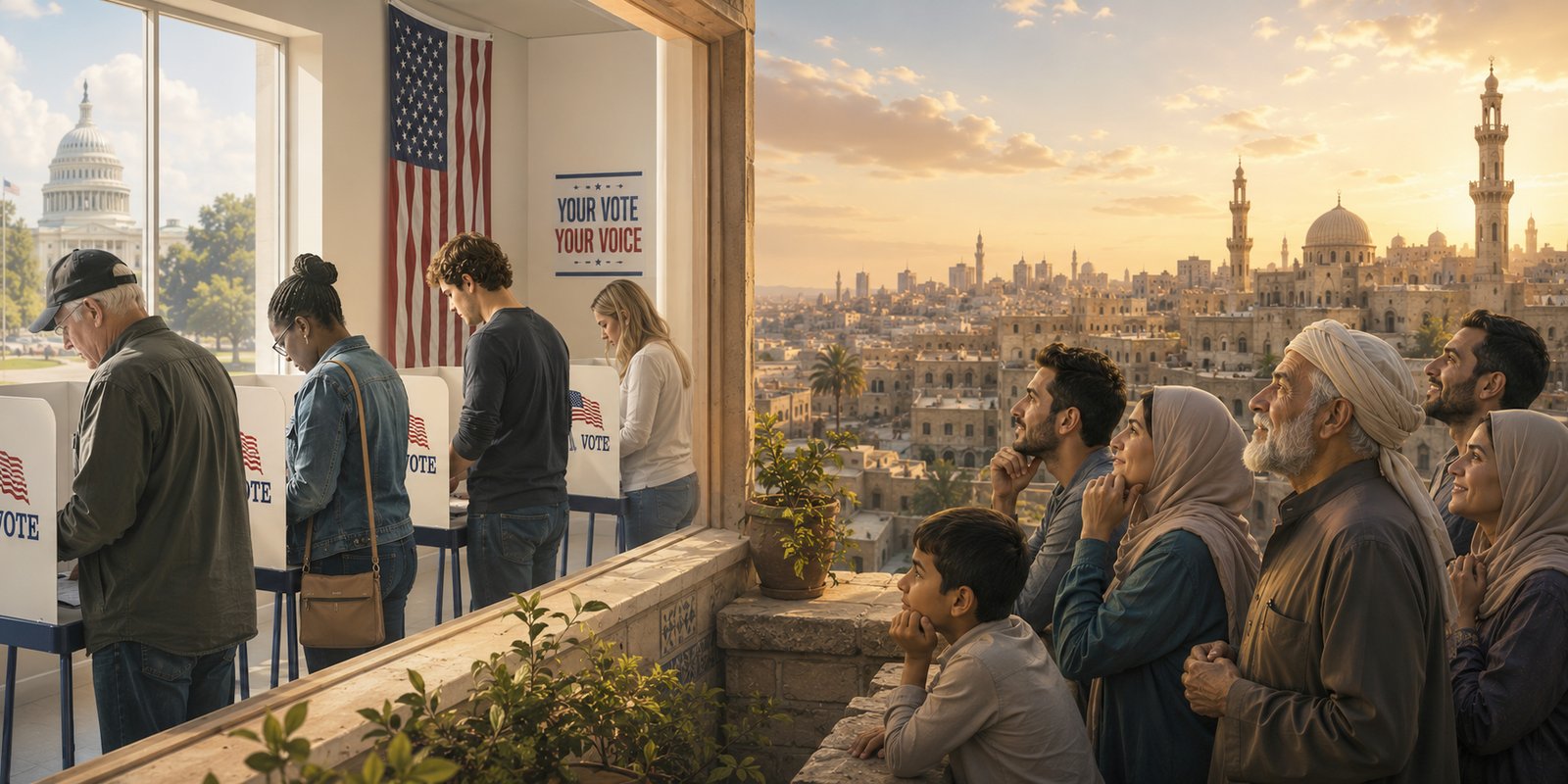
Much of the current discourse on the Middle East remains fixated on the US midterm congressional elections this coming November. This vote, in particular, is being framed as a pivotal turning point for everything from the survival of Gaza and Lebanon to the future of Iran and beyond.
To a large extent, one can understand why US corporate media is obsessed with this date.
US political power is divided between two ruling parties, each deeply embedded in an intricate system of powerful political and economic elites. For these groups, election results are decisive in shaping the overall direction of the country, but more specifically, they determine the fortunes and misfortunes of a ruling class whose very fate is tied to the corridors of power.
However, there is a distinct irony in this fixation. Rarely do ordinary Americans feel the direct impact of these results – at least not immediately – as the massive US economy seldom responds to sudden political stimuli. This is why, historically, Americans do not vote in large numbers, and why a vast majority continue to distrust their government, whether it is led by Republicans or Democrats.
The interest from Western commentators outside the US also makes a certain kind of sense. A victorious Republican party would strengthen President Trump, who would likely double down on his anti-NATO rhetoric and protectionist trade policies. Trade between Europe and the US would likely be upended by an empowered Trump, who would view a victory as a mandate to punish Europeans for failing to back his ‘maximum pressure’ military campaigns or for refusing to act as obedient junior partners ready to rubber-stamp every American decision, however reckless.
But what makes far less sense is the waiting game currently being played across the Arab world. This posture erroneously suggests that the future of our region – whether it be continued war or a path to peace – hinges entirely on the American vote.
While these elections are not irrelevant, the emphasis placed on them as the primary driver of Middle Eastern reality is greatly exaggerated. This obsession reflects both a lack of historical knowledge and a failure to recognize the agency of the peoples and leaderships of our own region.
History shows us that regardless of the party in power, the outcome of US interventionism remains remarkably consistent. Consider the following record:
President Bill Clinton, a Democrat, ordered the bombing of the Al-Shifa pharmaceutical factory in Sudan in August 1998 and of Iraq during Operation Desert Fox in December of the same year. Despite being perceived as a non-hawkish leader focused on the doctrine of ‘dual containment,’ Clinton frequently utilized military force in the Middle East to distract from his personal scandals at home.
George W. Bush initially sparked concern among the Washington Israel lobby for his perceived lack of pro-Israel appointments. Yet, he eventually waged catastrophic wars across the region in total alignment with Israeli strategic goals.
He was succeeded by Barack Obama, whose popularity among Arabs and Muslims exceeded that of any president in US history. Yet, his ‘kill list’ and ‘leading from behind’ strategy led to humanitarian disasters from Yemen to Libya.
Furthermore, his administration ensured Israel’s military dominance by signing the 2016 Memorandum of Understanding (MOU), guaranteeing $3.8 billion in annual military aid – the largest pledge in US history.
Donald Trump’s first term was preceded by arguments that his personal wealth would shield him from lobby manipulation. Instead, he sowed the seeds of the very chaos that engulfs us today. From unilaterally disrupting the Iran nuclear agreement (JCPOA) in 2018 to giving Israel a green light to further violate international law in Palestine, his tenure ensured the region remained in a perpetual state of conflict.
True, US foreign policy factors heavily into our current reality, from the ongoing genocide in Gaza to the regional wars and economic disruption of the whole region. Yet, whether Trump remains the uncontested ruler of America come November or becomes a ‘lame duck’ president, the fundamental trajectory of US policy toward the Middle East will not change as significantly as many would like to believe.
More accurately, the impact of the US elections will be as significant as we in the region allow it to be. If we remain dependent on US dictates and cues, we are merely subjects of an empire, discounting our own sense of agency and our own internal dynamics.
The enduring truth is that the US is a nation structurally tilted toward political control and economic domination. Neither this November nor any other will change that reality until the geopolitical realities in the Middle East change through our own initiative.
Instead of hoping for ‘change’ in November and hedging our bets on the Democrats, we must work to influence outcomes ourselves. The global balance of power is shifting, and our region is a primary candidate for the most significant change. We simply cannot afford to wait for November – or any other external date – in the hope of salvaged stability.
The focus must shift toward achieving true political independence, regional unity, and stability, irrespective of the political outlook of the White House.
The Middle East is brimming with opportunities, resources, and human capital that, if united, would allow us to be influential not only in our own affairs but in shaping the world around us – making it more stable, more representative of our people’s aspirations, and, ultimately, more just.
Join the Discussion!
We welcome thoughtful and respectful comments. Hateful language, illegal content, or attacks against Antiwar.com will be removed.
For more details, please see our Comment Policy.
[ad_2]
Source link
